
Case study: an apparel brand
Photography stopped being an event.
An apparel brand ran one photoshoot a month, and every launch waited for it. Seven months into Statixx it has not run a shoot, and four of every five products on its store carry Statixx imagery. Its owner also says the tool has not saved the company money or time. Both things are true, and the second is why you can trust the first.
- 0
- Photoshoots since starting Statixx
- 6,426
- Audited images produced, Feb to Sep 2026
- 79%
- Of live products carry Statixx imagery
- 61s
- Median generation run, garment to audited image
Who is the brand?
A direct-to-consumer apparel brand with about 185 live products and a small product team. It is vertically integrated and cost-conscious: photography was done in-house, so a shoot was mostly a model’s day rate and everyone’s time. The brand asked not to be named on anything indexable, which is a request we expect from most apparel brands using AI imagery. Its owner is quoted here with his permission.
Every number on this page comes from the brand’s own Statixx account, measured on September 16, 2026. Every quote is from the owner, in writing, on the same day.
What was the bottleneck?
Not the camera. The shoot happened once a month, and it could only photograph garments that were physically in the room. So every new product waited for the slowest sample, then waited for the shoot date.
“The biggest hurdle for us wasn’t the photo shoot to launching on the product page and editing. It was waiting for all the samples to come in to basically then do a photo shoot. So we had to have all the samples physically here to do a photo shoot, rather than being able to now generate images as they arrive. Because we’d only do one photo shoot at a time per month.”
That is a batching problem. The shoot was cheap. The queue in front of it was not.
What changed?
The brand connected its Shopify catalog to Statixx in February 2026. A product is now photographed the day its sample arrives, or before, from the garment’s reference photo. The product team runs the app directly: no brief, no studio date, no batch. One merchandiser on the team accounts for more than nine in ten of the images the brand has kept.
“We haven’t done any photo shoots since we started using Statixx.”
The ramp is the story. Eight images in the first month while the team learned the tool, a few hundred a month through spring, then a step change in June as new products started arriving with their imagery already made. Volume has held at several hundred images a month since, with no shoot behind it.
What do the numbers say?
Across 198 products, the brand produced 6,426 images and downloaded 1,844 of them: about one in four. That ratio is not waste. It is what a contact sheet looks like when the contact sheet is free. A shoot gives you the frames you got; Statixx gives you the frames you asked for, and the team keeps the ones that earn it.
- 6,426 images produced across 3,351 generation runs, 96% of which completed without error.
- 1,844 unique images kept (29%). 162 products have at least one kept image; the median product has four.
- 146 of the brand’s 185 live products (79%) carry Statixx imagery. Of the 80 products launched since March, 73 do (91%).
- Median run: 61 seconds from garment to an audited image. Nine in ten finish inside 98 seconds.
The launched-since-March figure is the one that describes the new normal: nearly every product the brand has introduced since it stopped shooting went live with Statixx imagery.
Did the fidelity audit matter?
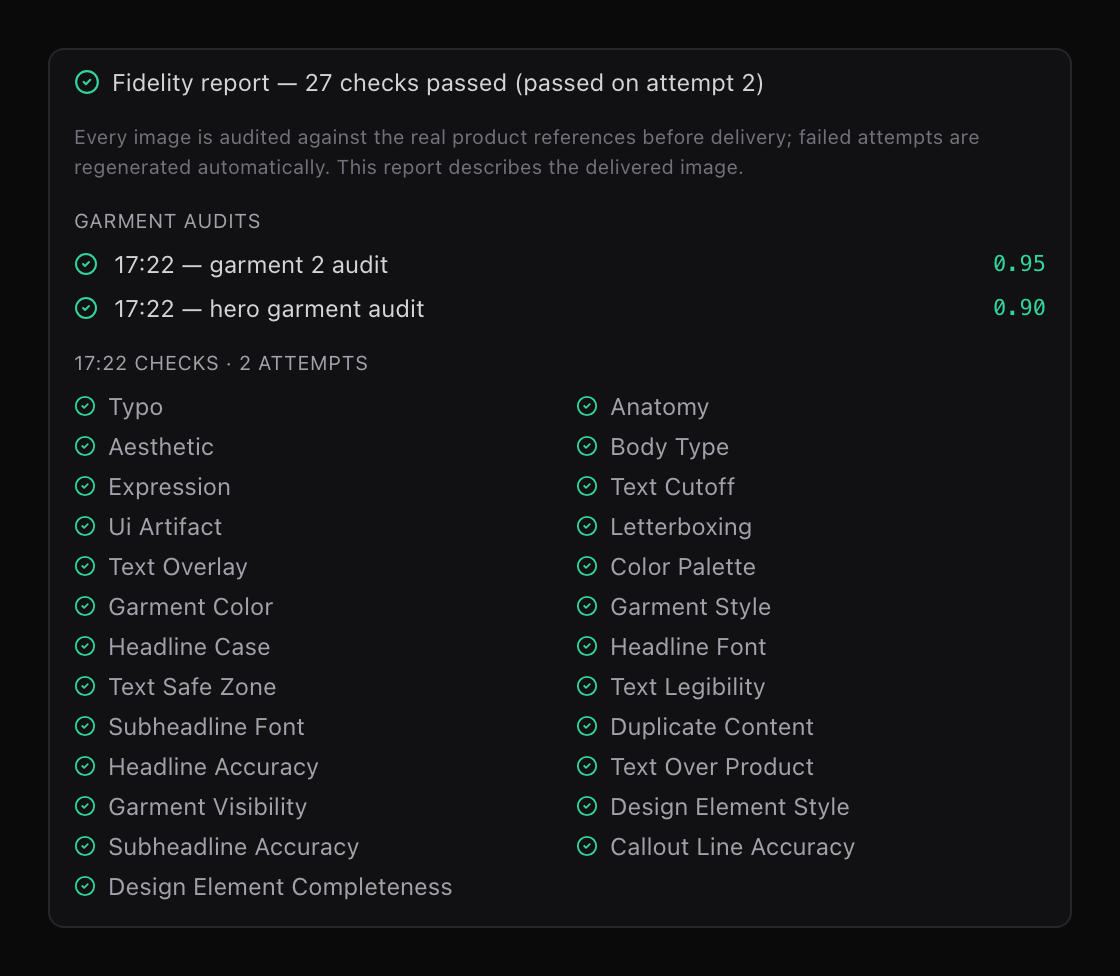
Yes, quietly. Every one of those images was checked against the real garment before anyone saw it. Across the brand’s main images, about 15% failed a check and regenerated automatically at least once; the average image took 1.15 attempts and none took more than three. The team never saw the failures. That is the difference between a tool that sometimes draws the wrong number of buttons and one that catches itself doing it.
Did it save money?
No. We asked, and the owner’s answer was direct.
“Statixx technically has not really saved us necessarily money or time. What it has saved us is the ability to generate more diversity, and also generate as products become available. Rather than waiting for photo shoots.”
This brand was already running the cheapest shoot in the industry: in-house photography and a model day rate, with no studio, agency, styling or retouching invoices to remove. If that is your shoot bill, Statixx is not a savings story either. It is a cadence story: the shoot stops being the thing a launch waits for. Brands that buy studio time, photographers and retouching are a different economic case, and we do not use this customer as evidence for it.
There is also no conversion or returns data here. The brand launched new products with Statixx imagery and left its older pages alone, so there was never a like-for-like comparison to run. We would rather say that than imply one.
What took iteration?
Fidelity. Some garments generate correctly on the first try; others do not, and the owner’s description is the honest one.
“It’s really difficult to get actual, very, very photo-accurate representation of the product. Some photos and products are extremely fast, while some things take [a lot of] tinkering to get right.”
The pattern we see in the account: solids and simple constructions land immediately. Prints at a specific scale, fine hardware, unusual sleeve and cuff shapes, and exact colors near their neighbors take rounds, and some are limited by what current image models can hold. The audit catches what drifts; it does not make every garment easy. Every correction the team flags becomes a standing rule on their pipeline, so the same mistake is checked for on every image after it.
What would we tell another apparel brand?
- Price the queue, not the invoice. This brand’s shoot was cheap. The month every product spent waiting for it was not. Ask what a launch waits for today.
- Expect cadence, not magic. Photography becomes something that happens when a product exists. Some products will still take rounds.
- Let the team explore. A one-in-four keep rate is the tool doing its job: many looks in, the right ones out, with the audit and a person in between.
- Decide up front whether you want performance data. If you want to know what Statixx imagery does to a product page, refresh an old page and compare. This brand did not, so it cannot say.
Book a walkthrough
See it on your own catalog.
A 30-minute walkthrough: a full spread generated live from one of your garments, and the fidelity report it ships with.